
What Is Kanban? Ultimate Guide to Kanban Principles
Ever wonder why strategic initiatives in your company stall? More often than not, the actual work gets lost in inboxes and chat threads. That’s exactly what Kanban was designed to fix. So, what is Kanban and how can this useful practice help you move towards a more effective organization? Organizations who are seeking business transformation often use this management operating model to help improve performance.
For business leaders, Kanban offers a clear window into how value moves from initial idea to finished project. It’s a simple, visual way to manage workflow (such as Work in Progress, or WIP) so teams can deliver faster with less chaos.
This all-inclusive guide dives deep into every facet of Kanban and its core set of principles. You will learn where this framework originated, what a Kanban board is, how to use it in practice, concrete Kanban examples, and how it ties into your overall agile strategy.
Ready to discover the secret power behind Kanban? Let’s start from the very beginning… What is Kanban and how was it created?
What Is Kanban?
Kanban is a flow-based method for managing work. Kanban started at Toyota in the 1940s, when teams used cards (known as kanban in Japanese) to signal when to pull more materials. By 1953, Toyota had officially adopted the Kanban card system in its machine shop. The system was ultimately used to promote Just-in-Time (JIT) delivery across the entire supply chain.
After the world saw Toyota’s success with Kanban, the methodology evolved beyond manufacturing into the tech industry and beyond. Now, the same idea applies to knowledge work: visualize your tasks and limit how much is in progress.

So, how exactly does Kanban work?
Push vs Pull: How Kanban Works
The basis of Kanban rests on push versus pull. Let us explain.
Instead of pushing more projects onto busy teams, Kanban creates a pull system. Work moves through clearly defined stages, like “To Do, In Progress, and Done,” with explicit rules. The goal is to optimize flow and avoid bottlenecks.
Here’s a more in-depth breakdown:
- Push: Work is based on a predetermined schedule or forecast, regardless of whether the team has the capacity to handle it.
- Pull: Tasks are only started when there is an actual demand for it and when the team has the available capacity to take it on.
Now, let’s paint you a picture so you can better understand push and pull.
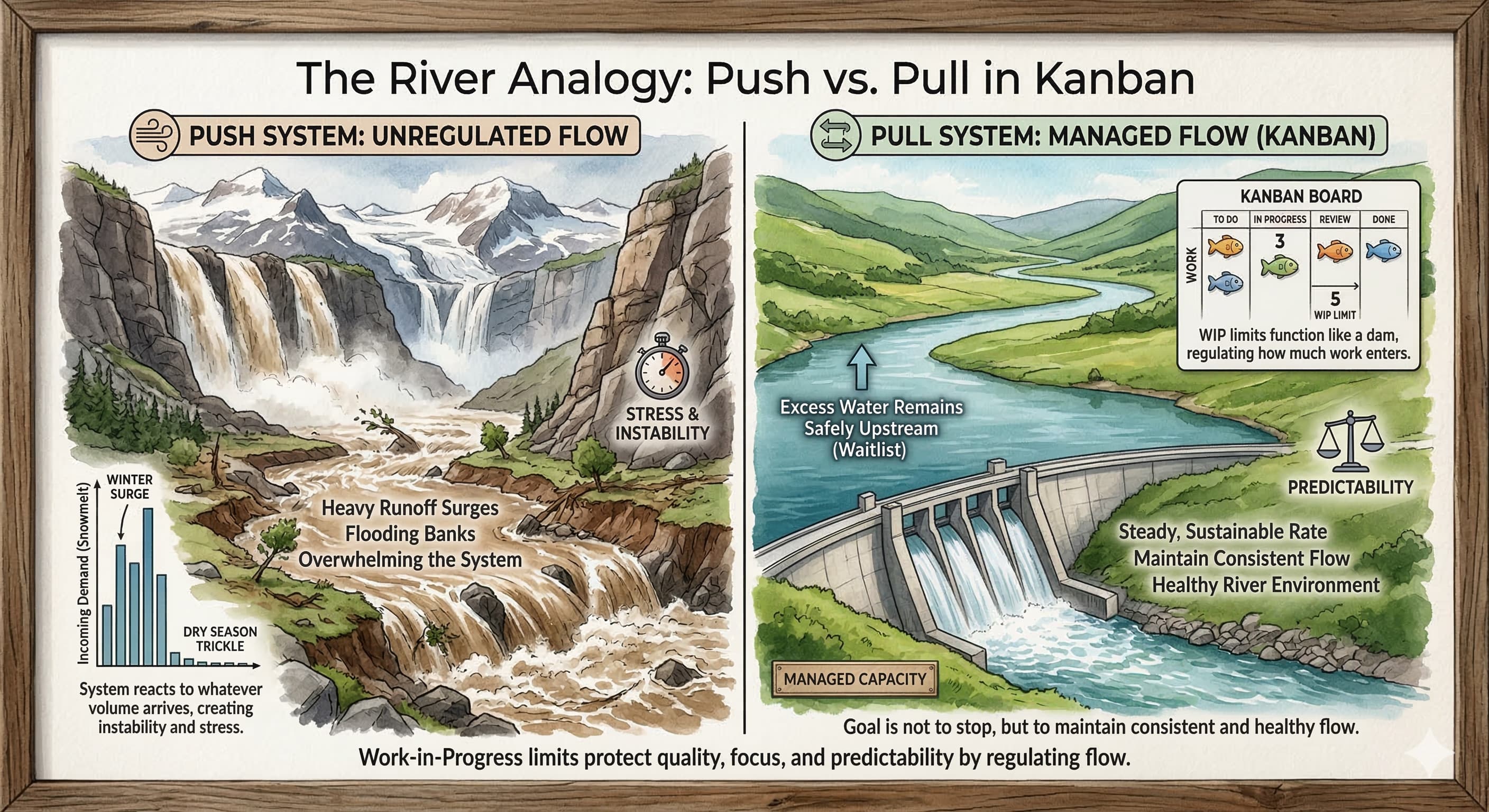
The River Analogy: Push vs. Pull in Kanban
Picture a river fed by seasonal snowmelt.
In a push system, heavy winter runoff surges downstream all at once, flooding banks and overwhelming everything in its path. In dry seasons, the flow shrinks to a trickle. The system reacts to whatever volume arrives, creating instability and stress along the river and the environment around it.
In a pull system, a managed dam regulates the flow. Water is released downstream at a steady, sustainable rate based on what the riverbed can handle. Excess water remains safely upstream until capacity becomes available. The goal isn’t to stop the river. Rather, it’s to maintain consistent and healthy flow.
Work-in-Progress limits function the same way. They don’t eliminate incoming demand. They regulate how much work enters the system at one time, protecting quality, focus, and predictability.
What Do Kanban Principles Look Like in Modern Business?
In practice, Kanban is a method you apply to your existing process, not a total replacement. You start where you are, visualize the current workflow, and gradually improve it based on data.
The main practices most teams adopt are:
- Visualize work on a shared Kanban board
- Limit Work-in-Progress (WIP) at each stage
- Make workflow policies explicit so everyone knows the rules
- Manage flow using feedback loops and data
At the end of the day, Kanban allows you to manage the flow of work across teams instead of just tracking isolated tasks. This improves efficiency and alignment.
By stabilizing and optimizing flow, Kanban helps organizations deliver value to customers more predictably, reduce delays, and make better economic decisions about where work should start and stop. By managing flow intentionally, organizations avoid overwhelming the system with more work than it can sustainably handle.
What is a Kanban Board?
You may have heard about Kanban boards if you’re considering agile. Agile transformation consulting firms that specialize in helping organizations adopt agile ways-of-working often help implement Kanban boards with teams and executives to help manage the work.
Simply put, a Kanban board is a visual model of your workflow. It has vertical columns for stages and cards for individual work items. Columns might include “Ready, In Progress, and Done,” reflecting how work actually flows.
Each card contains key information like a title, owner, and due date. WIP limits sit at the top of each column (for example, it might say “Max 5 items”), making it obvious when a stage is overloaded.
Digital Kanban tools mirror this structure with drag-and-drop cards and analytics. Whether physical or digital, the board’s purpose is the same: a single source of truth where everyone can see the status of work.
Kanban vs. Scrum
You might be wondering how Kanban differs from Scrum, the two most widely adopted Agile frameworks.
While both aim to improve value delivery and responsiveness, they differ in how they structure planning, manage flow, and define the jobs done on the team.
Scrum organizes work into short, fixed-length sprints with clearly defined roles and events. Teams commit to a Sprint Goal, deliver a working Increment, and inspect and adapt on a regular cadence. This structure provides clarity, rhythm, and defined ownership, which can be especially helpful for teams building complex products.
Work flows through the system as capacity becomes available, with explicit limits on work in progress to prevent overload. It emphasizes visualizing work, managing flow, and making policies explicit, often with fewer prescribed roles or events.
In practice, Scrum offers a structured operating model, while Kanban provides a flexible flow-based system. Many organizations choose the approach that best fits their work type, maturity, and need for structure.
Kanban vs. Traditional Project Planning
Traditional project planning approaches, such as Stage-Gate and Rolling Wave planning, emphasize upfront scope definition, milestone approvals, and phased delivery. Work is typically organized around large initiatives with predefined checkpoints, and change is managed through formal governance structures.
Kanban takes a different approach. Instead of organizing work into phases or milestones, it visualizes all work in progress and continuously manages flow. Rather than relying on detailed upfront plans, Kanban limits work in progress and uses real-time data to guide decisions about what to start, pause, or complete.

In traditional project models, predictability is achieved through planning accuracy. In Kanban, predictability is achieved through flow stability and capacity awareness. The focus shifts from managing tasks against a fixed plan to optimizing the system that delivers value over time. This makes Kanban particularly effective in environments with variable demand, shifting priorities, or ongoing service work, where flexibility and economic decision-making matter more than phase completion.
According to recent reports, organizations that adopt a flow-first mindset see around 30% faster cycle times and significant reductions in process delays. This is where Kanban really shines!
Who Uses Kanban?
Kanban is widely used in software, but its principles apply just as well in marketing, HR, and legal. Any team that moves work through stages can benefit from it.
For example, a marketing team might track campaigns from “Briefed” to “Launched.” An HR team could visualize hiring pipelines from “Sourcing” to “Hired.” The method adapts to your context instead of forcing a one-size-fits-all process.
Outcomes and Benefits of a Well-Designed Kanban System
When you implement Kanban thoughtfully, you get a system where work flows smoothly. More importantly, that smooth flow enables value to reach customers faster and with less variability. Teams focus on finishing, and leaders get real-time visibility into progress and risks. You start managing the flow instead of just reacting to problems.
For executives, this means more predictable delivery, faster response to market shifts, and healthier teams capable of sustaining performance over time.
Business-Level Benefits of Kanban
What are the benefits of using Kanban at scale? At its core, Kanban improves how reliably and sustainably value moves from idea to customer.
The main advantages include:
- Visibility: Leaders see how value is flowing, where it is stalled, and what is preventing customer impact.
- Predictability: Measuring lead time and throughput enables more reliable forecasting of when value will reach customers.
- Speed: Limiting WIP reduces context switching and shortens the time it takes for value to move through the system.
- Quality: Bottlenecks and rework become visible early, reducing the cost of defects and protecting delivered value.
- Engagement: Teams gain autonomy to improve their system, increasing ownership and sustaining high performance over time.
These benefits of Kanban are even more important as companies invest in AI. The J.P. Morgan 2026 U.S. Business Leaders Outlook reports that 62% of businesses plan to implement AI for process automation. This works much better when workflows are represented as “value streams” and can be easily visualized on Kanban boards.
Real-World Example: AI-Powered Flow at Transcom
To see these principles in action, consider the global customer experience firm Transcom. As detailed in TechTimes, the company integrated AI into their Kanban environment to gain real-time visibility into their workflows.
As the company used AI to analyze the movement of tasks, they were able to instantly surface hidden bottlenecks that were previously slowing down their customer service operations. Much like a well-managed dam regulating a river, the AI system identified where work was backing up and where flow needed to be stabilized.
The result was a significant reduction in service delays and a lighter administrative load. This allowed the team to focus on high-value customer interactions rather than managing a chaotic backlog.
A Step-by-Step Kanban Implementation Guide
Kanban is intentionally evolutionary. You don’t need new job titles or a wholesale reorganization to begin. You start with your existing process, make work visible, and improve it through disciplined flow management.
Minimal Prerequisites for Kanban Success
Before you begin, confirm a few essentials.
First, identify a defined service or workflow, whether that’s a product stream, an operations queue, or a support function. Be explicit about what types of work flow through the system. Ensure there is a stable group of people responsible for that service. Kanban improves how a team delivers value; it does not manage work in isolation from the people doing it.
Second, agree that work will be made transparent, even when that transparency reveals inefficiencies.
Third, commit to managing work as a flow system rather than a task queue. This means being willing to limit concurrent work to stabilize flow and protect delivery capacity.
Fourth, agree that improvement will be guided by observable data rather than opinion.
Finally, ensure leadership understands that bottlenecks and systemic constraints will become visible, and that the goal is to improve the system of work, not to blame individuals.
If your goal is to implement agile transformation in your organization, start with a single high-impact flow and use it as a pilot to learn and refine. Improve collaboratively, evolve experimentally, and expand only once flow and value delivery are stable and predictable.
Build Your First Kanban Board in 8 Steps
With the prerequisites in place, you can now design and implement your board.
Map Your Current Workflow
Clearly define the start and end points of the workflow. When does work officially enter the system? When is value considered delivered? Don’t design an ideal process yet.
The goal is to visualize reality, including messy steps and handoffs. This ensures the board represents how work truly flows.
Design Your Kanban Board Columns
Translate that workflow into columns. It helps to separate “waiting” from “doing” states, so queued work is more visible. For example, use “Ready for Dev” and “In Dev” rather than a single “Development” column. Keep the initial design simple. Three to seven active columns is usually enough. For each column, define explicit entry and exit criteria so everyone understands what must be true before work moves forward.
Define Work Items and Card Templates
Clarify what a card represents in your context: a user story, a support ticket, or a marketing campaign. Create a standard card template with fields like title, owner, and due date. Define clear entry policies so work is only pulled when it meets agreed-upon readiness criteria.
Set Initial WIP Limits
Choose conservative WIP limits for each active column based on team capacity. WIP limits are the maximum number of work items that can be in a specific column. A common starting point is to set WIP at or below the number of people actively working in that stage to reduce multitasking and expose bottlenecks. Emphasize that WIP limits are designed to shift based on whether they improve or hurt system flow.
These are commonly not permanent limits. You will adjust them later based on the data.
Establish Classes of Service
Not all work is equal. Define a small set of service classes, such as “Expedite” for urgent work, “Fixed Date” for items with deadlines, and “Standard” for most work.
For each class, create explicit policies on how it’s prioritized and visualized on the board. Ensure classes of service reflect business value and risk, not internal convenience.
Launch the Pull System and Daily Flow Review
Start using the board. Team members pull new work only when capacity exists and downstream WIP limits allow it, protecting flow stability across the system.
Introduce a short daily Kanban meeting focused on flow: where are items stuck, and what needs collaboration to get unblocked?
For distributed teams, combine the board with video or chat, similar to how you would properly manage distributed Scrum teams.
Introduce Metrics and Feedback Cadences
Begin tracking basic metrics: lead time, cycle time, and throughput (items completed per week). Hold regular flow review meetings to inspect these metrics and decide on small experiments. Focus on trends over time rather than single data points, and connect flow performance to customer impact and value delivery.
Connect these data points to your existing goal-setting structures.
Evolve and Scale Your Kanban System
After several weeks, review what the team has learned. Refine column definitions, update policies, and adjust WIP based on observed bottlenecks.
Once the first team’s system is stable, you can connect multiple boards into a portfolio view. Keep the evolution incremental so people experience Kanban as a support, not a disruption. Improve collaboratively and evolve experimentally rather than redesigning the system all at once.
Kanban for Different Teams and Functions
Kanban adapts to many types of work. Kanban is highly effective for operations teams, especially those with interrupt-driven work. Here are a few examples of how it might look across an organization.
- Software and product teams: Columns might include “Discovery, Ready for Dev, In Dev, In Test, and Released,” with swim lanes for features and bugs.
- Marketing: Stages such as “Idea, Planned, In Production, In Review, and Live,” with work items like campaigns and content assets.
- Operations and customer support: Boards focused on incident handling or service requests, often with explicit policies for expedite work.
- HR and talent acquisition: Pipelines like “Requisition, Sourced, Screening, Interviews, and Onboarded,” making hiring flow transparent.
When departments manage work with transparent flow systems, conversations about capacity, bottlenecks, and risk become grounded in observable data rather than opinion.
How to Track and Scale Kanban
Once the basics are in place, the next step is using data to drive strategic decisions.

This is where Kanban becomes more than a team task board. It becomes a management system for improving and scaling the flow of value across your organization. Using the data will help the team learn how to fine-tune their operations.
Core Kanban Metrics and Flow Analysis
Kanban’s strength is in quantifying how work moves, because the speed and stability of flow determine how quickly and predictably value reaches customers.
Four metrics are key:
- Lead time is the total time from request to delivery.
- Cycle time is the time from when work starts to when it finishes.
- Throughput is how many items you complete per week.
- Work in Progress is how many items are currently in active workflow states.
These metrics feed into visualizations like cumulative flow diagrams, which show how WIP builds up in each stage over time. Expanding bands signal accumulating WIP, often indicating bottlenecks or capacity imbalances.
Leaders can then address constraints with targeted improvements, such as simplifying approval paths, redefining policies, or rebalancing work to stabilize flow.
Portfolio-Level Kanban and Strategic Alignment
At the enterprise portfolio level, Kanban helps leaders manage investment flow across multiple teams and strategic initiatives. Instead of managing dozens of disconnected project plans, leaders can visualize strategic initiatives as a portfolio flow system with stages like “Validating, Committed, In Delivery, and Measuring Impact.”
At this level, Kanban shifts from a team improvement tool to a mechanism for managing strategic flow and organizational capacity.
This approach aligns closely with Lean Portfolio Management (LPM), which is a practice focused on managing investment flow, economic prioritization, and strategic alignment across the enterprise.
Here, economic concepts like cost of delay guide sequencing decisions, ensuring resources are allocated to the initiatives that create the greatest impact soonest. Connecting portfolio Kanban with OKR cycles creates transparency between strategic intent and execution, allowing leaders to see how investment decisions translate into measurable outcomes.
Pro-tip: Resources on effective OKR coaching and advanced OKR scoring can help ensure flow is tied to meaningful outcomes. Never underestimate the power of expert training!
Common Kanban Anti-Patterns and How to Correct Them
Like any method, Kanban can be misapplied. Here are a few common anti-patterns and their remedies.
- Board as a static to-do list: If items are added but rarely moved, the board isn’t driving behavior. Refocus daily discussions on flow and use WIP limits to expose and address constraints…
- Ignoring WIP limits: Treat WIP breaches as signals of overload or policy breakdown, and respond by stabilizing flow rather than pushing more work in.
- No explicit policies: Without clear rules on priorities and service classes, the board becomes ambiguous. Document simple policies directly on the board.
- Mixing different work types: When projects, incidents, and small requests share a system without defined classes of service, trade-offs become invisible. Use explicit service classes and visual differentiation on the board. Separate boards only when work truly belongs to different services.
- Lack of metrics: Capture and review flow metrics such as lead time, cycle time, and throughput to improve predictability and guide systemic improvement.
As you address these issues, your Kanban system will mature from a basic visualization to a data-driven system that informs strategic choices.
How to Put Kanban Into Action for Your Organization
Answering “what is Kanban” is just the first step. The real value comes when you map your workflows, limit WIP, and use data to guide your decisions. Start with a single team and let the evidence show you how to expand.
When Kanban is integrated with a clear strategy and OKRs, the impact can be huge. Hyperdrive Agile’s approach has helped organizations achieve outcomes like a 2x product release cadence and 6x productivity gains by aligning Kanban with business goals.
If you’re ready to turn Kanban from a simple board into a strategic flow system, partner with our Agile coaches at Hyperdrive. Together, you can use Agile methods like Kanban, Scrum, and SAFe to transform your business and build an organization that responds to change with confidence.
Get in touch today!
Frequently Asked Questions
How can leaders adapt performance management to support Kanban rather than undermine it?
Shift from individual utilization toward team-level flow outcomes, such as consistency and reliability. OKRs are great for managing team-level and organizational-level goals. Complement quantitative measures with qualitative assessments of collaboration and problem-solving.
How does Kanban support organizations with strict compliance requirements?
Kanban makes compliance work explicit by turning approvals and checks into visible steps with clear ownership. You can attach audit artifacts to cards and generate traceable histories that simplify audits.
When is Kanban not the most suitable project management approach?
Kanban is less effective when there is no stable service or workflow to manage, such as entirely bespoke, one-time initiatives with no repeatable delivery pattern. It can also struggle if leadership insists on fixed, long-term task plans and is unwilling to adjust priorities based on real-time information.
How can teams manage cross-team dependencies effectively in a Kanban environment?
Use explicit dependency markers on cards and create shared policies for how teams pull work from one another. Many organizations add a weekly sync where representatives review blocked cross-team items.
Questions? We Can Help.
When you’re ready to move beyond piecemeal resources and take your Agile skills or transformation efforts to the next level, get personalized support from the world’s leaders in agility.