
Scrum vs Agile Ultimate Guide: What's the Difference?
The confusion around Scrum vs Agile remains one of the most misunderstood topics in modern project management. Many organizations treat Agile and Scrum as interchangeable terms without understanding the underlying structure.
As a result, leadership teams invest heavily in uncoordinated training, excess tooling, and organizational restructuring, only to find that the ability to deliver sustainable value has not changed, and team engagement is even worse than before.
The issue is not with Agile or Scrum. The problem is confusion between distinct concepts.
So, what’s the difference between the two? Great question!
In this guide, we’re going to break down the differences between Agile and Scrum, and explain how you can leverage both to improve value delivery.
Agile vs Scrum: What’s the Difference?
Before choosing between Scrum vs Agile, it is absolutely necessary to understand the relationship between Agile and Scrum at a foundational level.
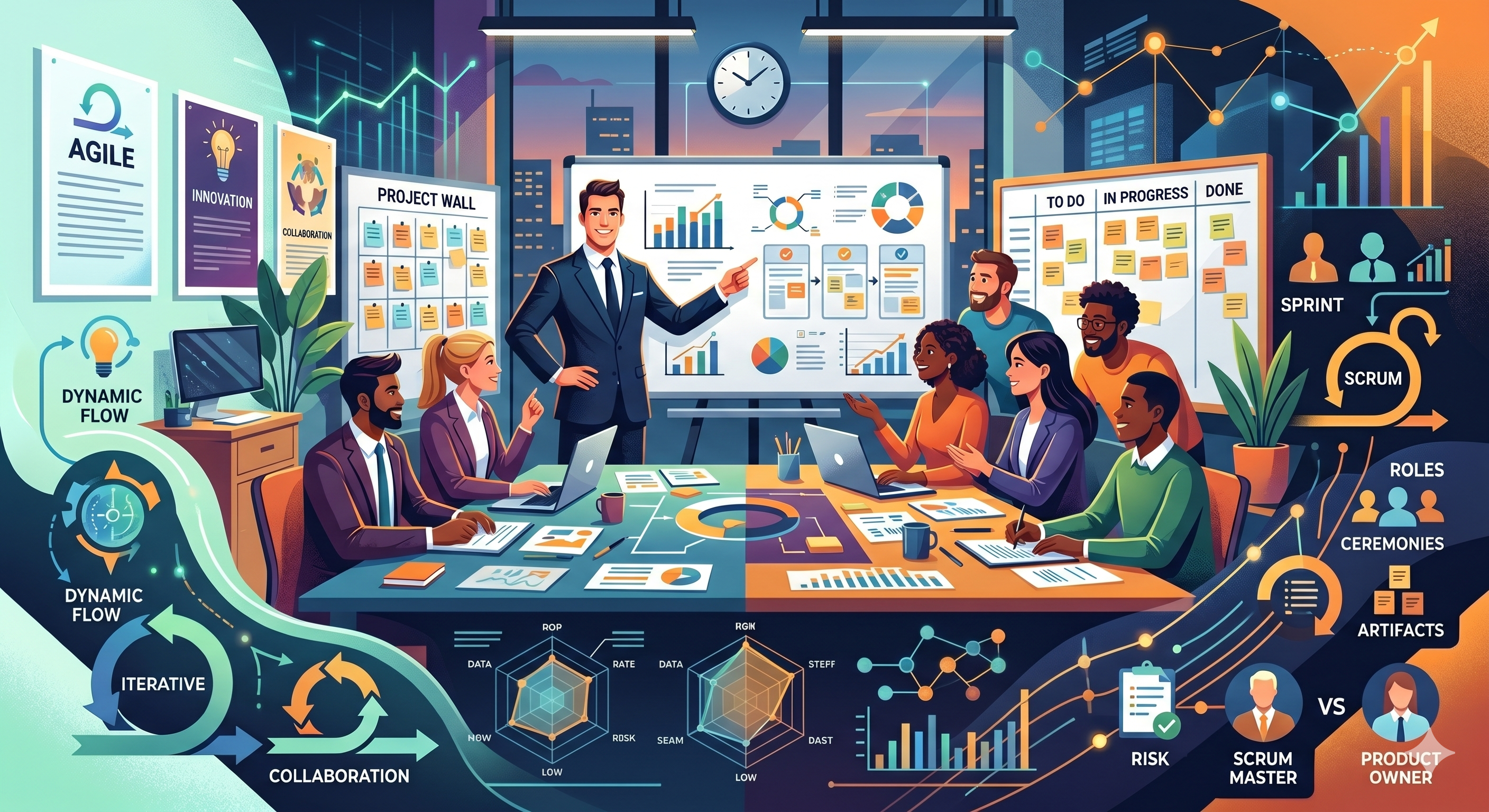
Let’s break it down for you.
What Does Agile Mean?
Agile is an umbrella term representing several types of frameworks. It is an approach that helps people, teams, and organizations deliver value in a world of constant change.
When a business goes agile, the transformation is grounded in a set of values and principles that guide how work gets done, decisions get made, and teams adapt when circumstances shift.
The power of agile for business is that it incorporates a new mindset and a philosophy for managing uncertainty and risk through short iterative development, fast customer feedback, and creating a culture of continuous learning.
What Does Scrum Mean?
Scrum, sometimes referred to as a methodology, is one of the most popular agile frameworks. It is a lightweight framework that helps teams and organizations deliver value using defined accountabilities, events, and artifacts. Scrum provides structure, but it does not replace the need for leadership alignment or strategic clarity.
So, why is it important to know the difference between the two?
For starters, understanding this distinction allows organizations to apply the right level of structure without sacrificing adaptability.
Let’s dive a little deeper into the nuances of Scrum vs Agile.
Agile in Business Terms: Principles Before Process
You might be wondering, “What exactly is agile and how can it transform my business?” Let us explain.
The Agile Manifesto emerged as an alternative to the style of rigid phase gate project management commonly referred to as waterfall methodology. It codified core values and principles of several frameworks and approaches that were designed to break the rigid planning, fixed scope cycles, and deliver value to customers in shorter learning cycles.
At its core, agile methodology seeks to:
- Prioritize individuals and interactions over rigid processes
- Prioritize working product over comprehensive documentation
- Use customer feedback to guide decisions
- Embrace change as projects evolve
Through the use of flexible business frameworks and methods that promote strategy and execution, these agile principles have helped transform businesses and their teams in virtually every industry.
For example, agile principles can help leaders shape stronger product visions that better aligns teams to OKRs and de-risks investments. Today, Agile informs enterprise-wide project management, marketing operations, HR initiatives, and leadership decision-making.
The Agile Mindset for Businesses
In an Agile environment, teams and organizations focus on outcomes instead of outputs. For example, plans evolve as the project progresses. At the same time, the true marker of agile leadership is a shift from directing task execution to pushing decision-making closer to where the work happens, strengthening cross-functional teams that deliver value without unnecessary delay.
When organizations genuinely embrace an agile philosophy, teams and organizations align, decisions get made closer to the work, risk is reduced, waste is minimized, delivery naturally accelerates, and valuable outcomes are created.
For many organizations, breaking silos and bottlenecks becomes the first visible step in a broader move toward business agility.
Now, let’s talk about Scrum. How does it tie into Agile and how can businesses see success through it?
How to Visualize the Agile Ecosystem
A useful way to picture agile is to look at it as a layered system:
- At the top sits agile values and principles
- In the middle are frameworks like Scrum, Kanban, and Extreme Programming as well as scaling approaches such as SAFe and Scrum@Scale.
- At the base are practices such as iterative delivery, continuous feedback, and regular retrospection.
This distinction matters. If you try to implement Scrum without first embracing Agile values, it can lead to rigid ceremonies and disengaged teams (which is the direct opposite of what you want). Conversely, adopting Agile values without an execution step such as Scrum can send your organization into chaos and confusion.
For organizations navigating constant change, leadership must support both an Agile approach and a specific Agile framework such as Scrum.
Scrum in Business Terms: Execution Through Structure
Where Agile provides direction, Scrum provides execution.
Scrum is a specific agile framework designed for generating value in complex work domains, especially software development and new product delivery. Moreover, Scrum has been proven to work well in marketing, operations, and multiple industry sectors.
So, how does it work?
When you really look at it, it’s straightforward: Scrum organizes the delivery toward a long-term value goal (The Product Goal) into fixed-length iterations called Sprints, usually lasting one to four weeks.
These Sprints serve as concrete stepping stones toward the longer-term goal, breaking up large, daunting work into bite-sized tasks that teams can focus their time and energy on. The structured Sprint cycle reduces confusion across the organization and teams. This allows for the innovation and evolution of products as teams work through each Sprint.
Anatomy of a a Scrum Team
Each Scrum Team includes:
- A Product Owner responsible for maximizing value
- A Scrum Master who enables the team and removes impediments
- A number of cross-functional Developers who are accountable for building the product.
Scrum also defines five core events, the Sprintprint Planning, Daily Scrum, Sprint Review, and The Sprint Retrospective. These Scrum Events create a rhythm for delivery, inspection, and continuous improvement of the delivery of value.

For leaders and project managers, Scrum provides transparency. You see what the team committed to, what was delivered, and what obstacles remain. This structure makes Scrum particularly effective for complex projects with high uncertainty.
Agile and Scrum in Practice: Two Layers, One System
Many organizations approach Agile and Scrum as either/or decisions choosing one over the other, or treating them as the same thing. In practice, they operate at different levels of the organization and work together. Agile shapes how the organization thinks and makes decisions. Scrum provides the structure through which teams act on those decisions and deliver value.
Confused? Let us simplify it for you.
Agile defines the mindset. Scrum is one way to put that mindset into action. Think of it this way…
The Chef Analogy
Agile is your philosophy and mindset, like a chef’s commitment to making fresh, delicious Italian meals that people love. Meanwhile, Scrum is your recipe, providing the specific steps and timing needed to actually get that meal onto the table.
You don’t choose between being a chef or using a recipe. You simply use the recipe (the Scrum framework) to practice your craft (Agile business transformation). Ultimately, Agile provides the “why,” and Scrum provides the “how.”
The real question for leaders is where Agile principles should guide the organization broadly, and where a specific agile framework like Scrum should be applied at the team level.
Some teams benefit from Scrum’s structure. Others operate better with flow-based systems such as the Kanban framework, especially in environments with continuous inflow of work. Speaking of frameworks…
Why Framework Choice Impacts Performance for Agile vs Scrum
Framework choice directly affects governance, delivery outcomes and how project management decisions get made across the organization. In practice, adding the right framework to your business transformation will:
- Establish a clear focus on value delivery, ensuring teams and leadership stay aligned on outcomes rather than activity
- Provide role clarity to reduce bottlenecks and silos
- Create consistent cadences to improve visibility
- Offer a shared language to increase coordination in the project team and across the organization as a whole
Many organizations combine Scrum at the team level with broader agile project management practices across portfolios. This hybrid approach prevents Agile from becoming disconnected from real delivery work.
For organizations ready to build these capabilities internally, Hyperdrive’s Agile Teams training focuses on enabling sustainable delivery of value and execution rather than ceremony compliance.
Scrum vs Agile: The Top 4 Differences Leaders Must Understand
The following key differences explain why confusion between Agile and Scrum often undermines results.
1. Organizational Scope
Both Agile and Scrum impacts every level of the organization. Whether you’re working in management or on a team, Agile guides your direction while Scrum is how you operate.
Agile shapes strategy, funding models, and leadership behavior. Scrum structures how agile teams execute within that environment.
2. Planning and Cadence
Agile supports planning as a continuous activity, allowing organizations to respond to new information and shifting priorities without being locked into a fixed plan.
Scrum operationalizes this through time-boxed Sprints, each anchored to a Sprint Goal that keeps the team focused on delivering a specific piece of value.
Sprint planning, the Product Backlog, and Sprint Reviews create focus while still allowing adaptation between iterations.
3. Roles and Accountability

Agile encourages collaboration but does not prescribe specific roles or jobs.
Scrum defines who does what clearly. The Scrum Master enables flow. The Product Owner prioritizes value. The developers deliver valuable outcomes together as a cohesive unit.
This clarity supports cross-functional teams and reduces dependency-driven delays.
4. Metrics and Governance
Agile focuses on outcomes and learning. Scrum adds operational visibility through metrics that matter.
Effective Agile metrics measure what organizations actually care about: value delivery, predictability, quality, and team sustainability. Used responsibly, they support better decisions and continuous improvement. Used irresponsibly, they drive gaming, burnout, and misalignment. Business outcomes remain the ultimate measure of success.
Velocity, throughput, and predictability support transparency, but they should never replace business outcomes as success measures.
Dive into Agile Business Transformation and Scrum with Confidence
As you can see, the debate isn’t really around Scrum vs Agile. Rather, when applied correctly, Agile and Scrum reinforce each other. Agile provides direction while Scrum provides discipline.
Organizations that succeed stop debating terminology and start designing systems that align agile framework choices with business goals, team maturity, and risk profiles.
At Hyperdrive, we work with leaders navigating these challenges. We help organizations close the gap between strategic intent and real delivery outcomes.
Whether that means redesigning how work flows across the organization, aligning leadership around a value-based operating model, or building internal capability through Scrum certifications and business transformation coaching, we meet organizations where they are.
Ready to have a valuable conversation about what’s actually getting in the way? Contact us to learn more!
Frequently Asked Questions
How do we decide between Scrum and Kanban?
Scrum excels in complex work where the exact solution or path to the solution is unclear. Greenfield development, new feature development, and any kind of design work (marketing design, creative projects, content creation, etc.) can benefit from the use of Scrum. Its time-boxed focus and regular inspection loops allow for a flexible approach to value creation that has strong feedback cycles with stakeholders and customers. Kanban supports three distinct organizational needs.
First, it excels in guiding complicated work that requires deep expertise and structured flow such as legal reviews, financial operations, and product maintenance. Here, it delivers high predictability with minimal overhead. It is also a natural evolution for mature Scrum teams that have moved beyond needing Scrum’s cadence and are ready for continuous flow delivery.
At the portfolio level, Kanban provides leaders with visibility into the flow of work across multiple teams and initiatives (value streams), making capacity constraints and competing priorities visible before they become delivery problems.
Scrum vs Agile: Can Agile work without Scrum?
Yes, Agile is a set of patterns built around strong values and principles that can guide better decision-making in leadership, governance, and strategy, with or without a specific framework like Scrum or Kanban. Organizations that build operations around Agile patterns create resilient systems capable of delivering value in the unpredictable business environment that has become the norm in most industries.
Agile principles even strengthen traditional project management approaches. Both the Project Management Institute and PRINCE2, the world’s leading project management bodies, have formally adopted Agile principles as a core part of their approaches, reflecting how broadly applicable Agile thinking has become.
Does Scrum work outside software development?
Yes, Scrum has found its way into every corner of the modern business environment and well beyond. Its focus on delivering value in complex environments has proven broadly applicable, supporting work as diverse as marketing, education, research, hardware, and strategic planning in defense departments worldwide.
What tools support Agile and Scrum teams?
Agile and Scrum teams typically rely on three categories of tools: work management platforms for tracking backlogs, Sprints, and flow (such as Jira, Azure DevOps, KanbanZone, or Monday.com), collaboration tools for distributed teams (such as Miro and Mural), and reporting tools that surface delivery metrics and trends for leadership visibility (such as ActionableAgile, or built in analytics withing Jira or Azure DevOps).
Tool choice should support process clarity. Organizations that implement tooling before establishing clear ways of working typically find the tools amplify their existing confusion rather than resolve it.
What causes Scrum implementations to fail?
As with any organizational change, Scrum needs a clear reason for change, strong leadership sponsorship, and a commitment to removing systemic impediments. At the team level, the most common failure patterns are unclear role implementation, weak product direction, and poorly implemented Scrum events.
How do we implement Scrum successfully?
Successful Scrum implementation starts before the first Sprint. It requires a meaningful product goal, a stable cross-functional team, clear accountabilities, and leadership willing to protect the team’s focus and remove systemic impediments. The mechanics of Scrum are straightforward. The challenges come in how the organizational conditions allow it to succeed or fail. For a comprehensive step-by-step guide to launching your first Scrum team, check out this Scrum 101 Guide.
Questions? We Can Help.
When you’re ready to move beyond piecemeal resources and take your Agile skills or transformation efforts to the next level, get personalized support from the world’s leaders in agility.