
How Project Managers Can Effectively Lead Self-Managing Teams
How Project Managers Can Effectively Lead Self-Managing Teams
Discover how PMs can support teams without taking over.
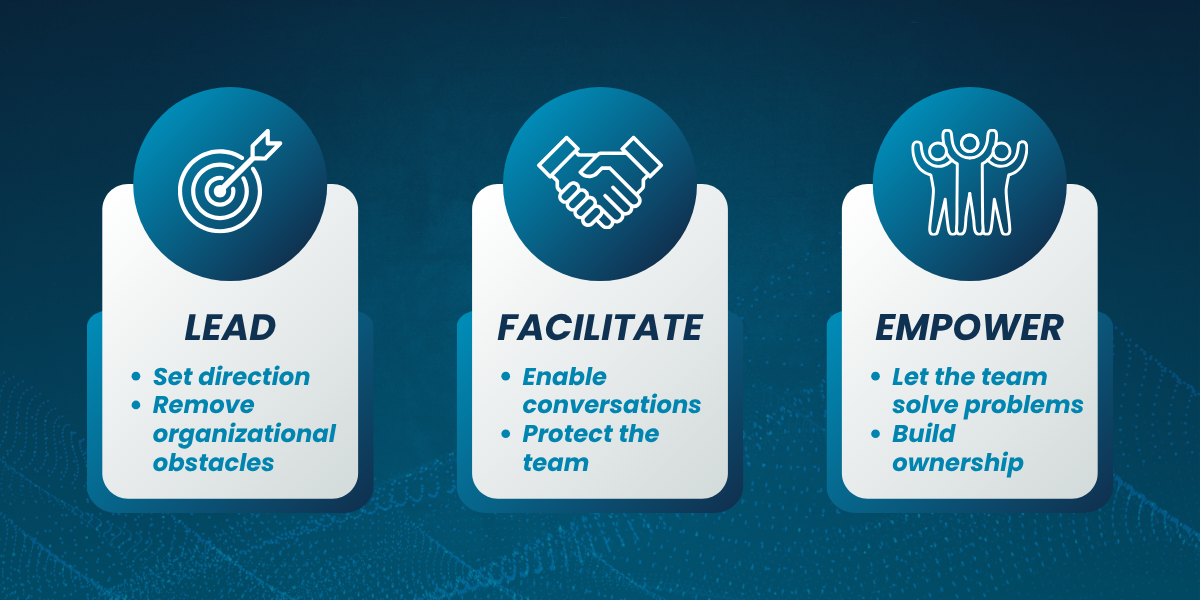
As a project manager, you’ve probably been told that Scrum teams don’t need your leadership because the teams are ‘self-organizing’. While Scrum teams have more autonomy than before, it’s not a free-for-all. Scrum teams need the leadership skills you bring now more than ever. The big difference is how you lead self-organizing teams. Leadership takes on a new meaning with agile, and you play a significant role. With just a few small tweaks, you’ll be able to clearly articulate that your leadership adds value, not conflict.
Distilling the Myth: Self-Managing Teams Don’t Need Leadership
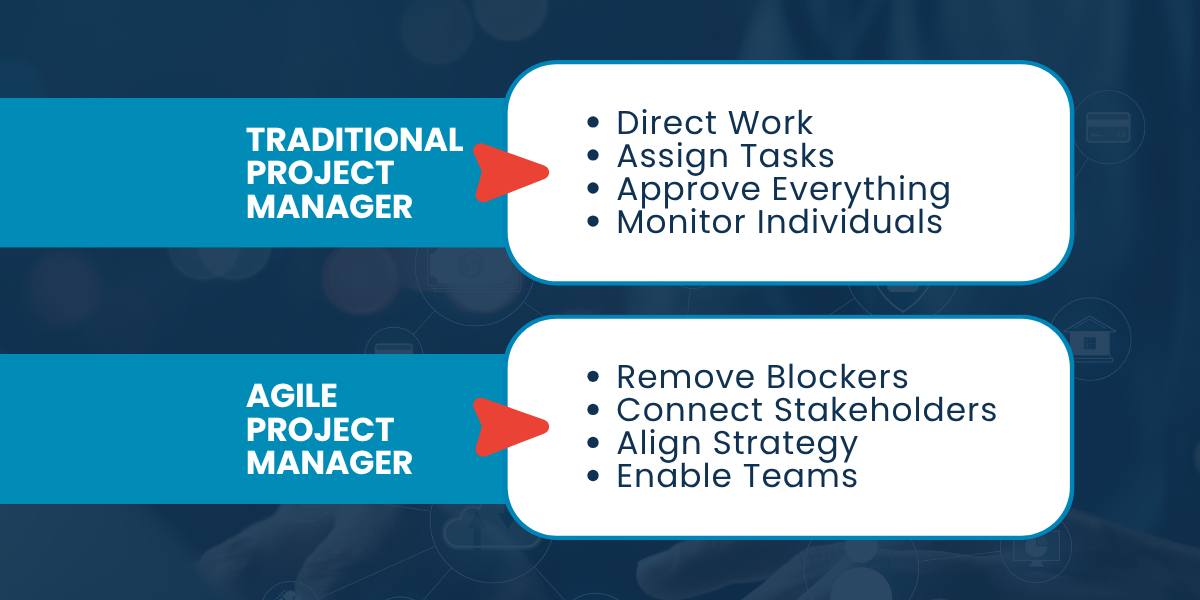
In many companies, people mistook ‘self-managing’ for needing no authority whatsoever, and that myth has caused a lot of conflict between Scrum teams and project managers. But if Scrum teams had no guardrails, they might build really cool widgets that nobody wants, have communication breakdowns with stakeholders, be unable to make decisions, and face misalignment with strategic priorities.
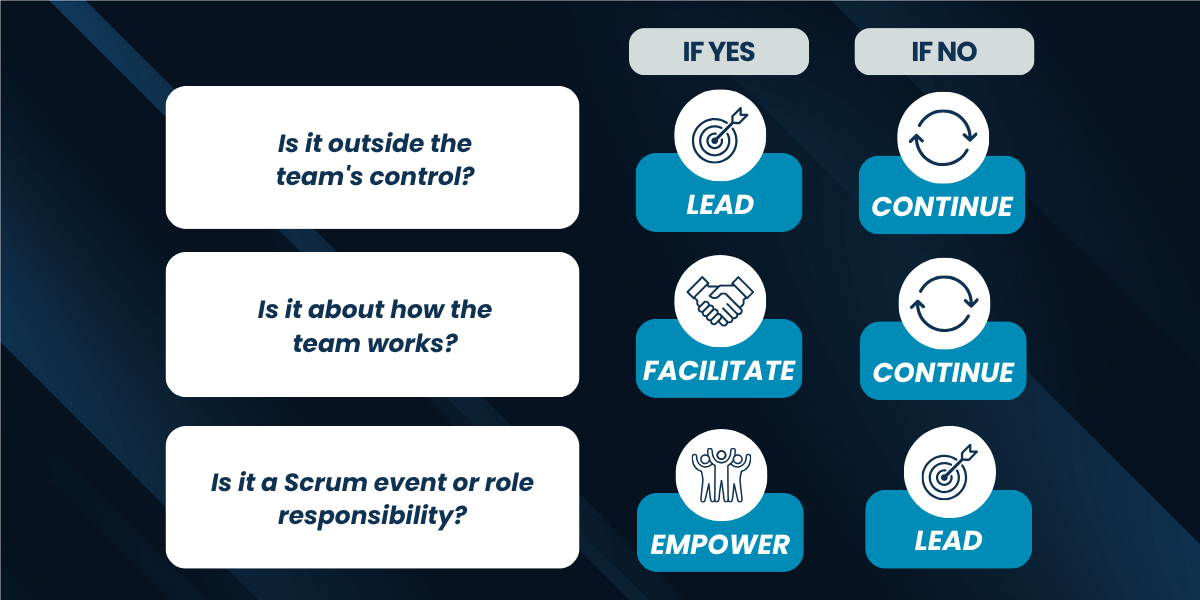
You have all the right skills to be an outstanding leader for a Scrum team, but you need to know when to lead (and how it’s different), when to facilitate, and when to empower the team to work it out.
When Project Managers Should Take the Lead
Now that you’re working with Scrum teams, leading changes. Instead of command-and-control leadership, your leadership style becomes more helpful, serving the team and removing obstacles that may get in the way. It’s also to bridge communication with stakeholders and other teams. Your leadership now is more like the glue that holds a project or program together, rather than the one who tells people how to apply it.
To break it down, most of your leadership happens outside of the Scrum team. The day-to-day duties on an individual team stay with the team, and meddling there may cause friction.
Here are a few examples of when you’ll want to take a leadership stance:
#1) Cross-team and cross-program communication
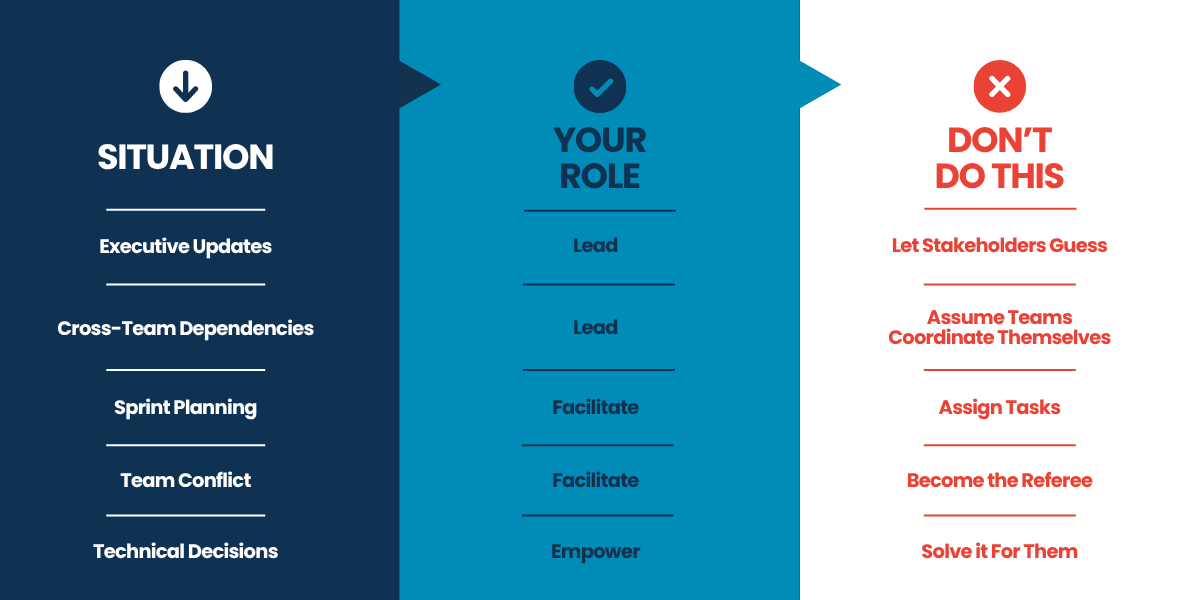
The Scrum team only has eyes on their own work, so it’s important that you take a lead in understanding what’s happening across the entire program, so your job takes on a higher level of authority where you’re casting a wider lens. You’re looking at cross-team dependencies and external vendors, and talking with non-Agile departments that are critical to getting work across the finish line, such as finance, legal, and procurement. Someone has to own the big picture, and this is a natural leadership zone for project managers.
#2) Stakeholder and executive management
While product owners own the product backlog and value trade-offs, they typically have visibility only into their team. They also might not be used to managing upward, so that’s where your skills are needed. You may lead conversations with steering committees and sponsors, obtain budget approvals, and secure contracts. As a project manager, translating sprint-level progress into business and financial narratives for leadership is a necessary function.
#3) Resource and capacity planning across teams
While Scrum teams are meant to remain stable throughout a project, organizations may still need to hire and onboard additional people to manage it. Resolving resourcing conflicts is an area that is outside of Scrum.
When Your Role is a Facilitator
On the flip side, when do you step back from leading and take on a facilitator stance? When the goal is team empowerment or the execution of work, you should facilitate.
Once priorities are set, how the team breaks down and executes work tasks within a sprint becomes part of the team’s ownership, rather than the project manager’s. A project manager jumping in on how a developer solves a problem undermines the whole point of Scrum. Your job is to remove obstacles, not assign work.
Here’s how to tell when you’re facilitating rather than leading. If the duty falls into the ownership of a Scrum role or meeting, your job is to facilitate. You can provide context, remove blockers, and protect focus.
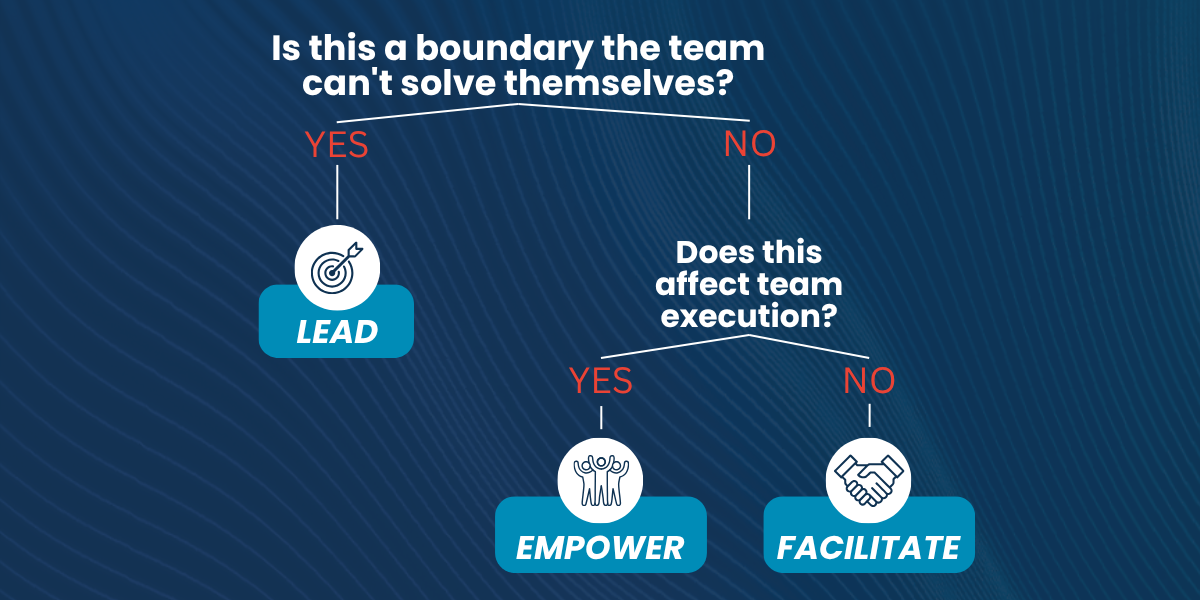
Here’s a quick gut-check: If you’re about to give a directive, ask, “Is this crossing a boundary the team can’t see or reach on their own?” If yes, lead. If not, facilitate.
Empowering the Team to Self-Organize
Empowering the team to self-organize is probably one of the hardest things for project managers to do. After all, there’s an aspect of control that’s difficult to give up, especially if you know the answer. However, with Scrum teams, taking a back seat is necessary so they learn to solve problems on their own, and you can keep your eyes on the forest rather than the trees.
The easy way to know whether empowering the team is the right stance is to ask yourself, “Does this have to do with how the team works?” The ‘how’ is owned by the team, so if they ask you to solve the problem for them, you’ll want to redirect the conversation.
If someone asks, “How do I get James to review my work faster?” it’s natural to jump in and problem-solve, but in this case, the two of them need to figure it out together. So instead of saying, “I’ll talk to James”, you should encourage them to talk to each other.
Learn Scrum for Project Managers
If you’ve ever wondered how project management fits within Scrum—or how to remain an effective leader in an agile organization—our Scrum for Project Managers course was designed specifically for you.
You’ll learn how to work with Scrum teams, manage dependencies, communicate effectively with stakeholders, forecast delivery, and lead without relying on command-and-control practices.
Whether you’re new to Scrum or looking to sharpen your agile leadership skills, this course provides practical techniques you can apply immediately.
Learn more about Scrum for Project Managers, and get the skills you need to thrive in a Scrum organization.
Questions? We Can Help.
When you’re ready to move beyond piecemeal resources and take your Agile skills or transformation efforts to the next level, get personalized support from the world’s leaders in agility.